

2025 Valid NSE8_812 Dumps for Helping Passing Fortinet Exam!
Download Free Fortinet NSE8_812 Exam Questions & Answer
Fortinet NSE8_812 (Fortinet NSE 8 - Written Exam (NSE8_812)) is a certification exam that validates the advanced knowledge, skills, and expertise of network security professionals in designing, implementing, and managing complex security solutions. It is intended for individuals who are responsible for implementing and managing security infrastructures using Fortinet products and technologies. Fortinet NSE 8 - Written Exam (NSE8_812) certification exam is an eight-hour written test that assesses the candidate's ability to design, configure, and troubleshoot complex network security solutions.
The NSE8_812 certification is a globally recognized certification that demonstrates your expertise in advanced security concepts and Fortinet products. Achieving this certification can open up new career opportunities, increase your earning potential, and provide you with the skills and knowledge needed to design and implement advanced security solutions using Fortinet products. Additionally, the NSE8_812 certification is a requirement for certain advanced-level Fortinet partner programs, making it a valuable credential for Fortinet partners and resellers.
Fortinet NSE8_812 exam is a certification exam that is designed to test the skills and knowledge of network security professionals who work with Fortinet products and solutions. NSE8_812 exam is intended for individuals who are seeking to become certified as Fortinet Network Security Experts (NSEs) at the highest level. The NSE8_812 exam covers a wide range of topics, including advanced routing and switching, advanced firewalling, advanced VPN technologies, and advanced threat protection.
NEW QUESTION # 60
SD-WAN is configured on a FortiGate. You notice that when one of the internet links has high latency the time to resolve names using DNS from FortiGate is very high.
You must ensure that the FortiGate DNS resolution times are as low as possible with the least amount of work.
What should you configure?
- A. Configure two DNS servers and use DNS servers recommended by the two internet providers.
- B. Configure an SD-WAN rule to the DNS server and use the FortiGate interface IPs in the source address.
- C. Configure local out traffic to use the outgoing interface based on SD-WAN rules with a manual defined IP associated to a loopback interface and configure an SD-WAN rule from the loopback to the DNS server.
- D. Configure local out traffic to use the outgoing interface based on SD-WAN rules with the interface IP and configure an SD-WAN rule to the DNS server.
Answer: D
Explanation:
SD-WAN is a feature that allows users to optimize network performance and reliability by using multiple WAN links and applying rules based on various criteria, such as latency, jitter, packet loss, etc. One way to ensure that the FortiGate DNS resolution times are as low as possible with the least amount of work is to configure local out traffic to use the outgoing interface based on SD-WAN rules with the interface IP and configure an SD-WAN rule to the DNS server. This means that the FortiGate will use the best WAN link available to send DNS queries to the DNS server according to the SD-WAN rule, and use its own interface IP as the source address. This avoids NAT issues and ensures optimal DNS performance. References:
https://docs.fortinet.com/document/fortigate/7.0.0/sd-wan/19662/sd-wan
NEW QUESTION # 61
A remote worker requests access to an SSH server inside the network. You deployed a ZTNA Rule to their FortiClient. You need to follow the security requirements to inspect this traffic.
Which two statements are true regarding the requirements? (Choose two.)
- A. FortiGate can perform SSH access proxy host-key validation.
- B. You need to configure a FortiClient SSL-VPN tunnel to inspect the SSH traffic.
- C. SSH traffic is tunneled between the client and the access proxy over HTTPS
- D. Traffic is discarded as ZTNA does not support SSH connection rules
Answer: A,C
Explanation:
ZTNA supports SSH connection rules that allow remote workers to access SSH servers inside the network through an HTTPS tunnel between the client and the access proxy (FortiGate). The access proxy acts as an SSH client to connect to the real SSH server on behalf of the user, and performs host-key validation to verify the identity of the server. The user can use any SSH client that supports HTTPS proxy settings, such as PuTTY or OpenSSH. Reference: https://docs.fortinet.com/document/fortigate/7.0.0/ztna-deployment/899992/configuring-ztna-rules-to-control-access
NEW QUESTION # 62
SD-WAN is configured on a FortiGate. You notice that when one of the internet links has high latency the time to resolve names using DNS from FortiGate is very high.
You must ensure that the FortiGate DNS resolution times are as low as possible with the least amount of work.
What should you configure?
- A. Configure two DNS servers and use DNS servers recommended by the two internet providers.
- B. Configure an SD-WAN rule to the DNS server and use the FortiGate interface IPs in the source address.
- C. Configure local out traffic to use the outgoing interface based on SD-WAN rules with a manual defined IP associated to a loopback interface and configure an SD-WAN rule from the loopback to the DNS server.
- D. Configure local out traffic to use the outgoing interface based on SD-WAN rules with the interface IP and configure an SD-WAN rule to the DNS server.
Answer: D
Explanation:
SD-WAN is a feature that allows users to optimize network performance and reliability by using multiple WAN links and applying rules based on various criteria, such as latency, jitter, packet loss, etc. One way to ensure that the FortiGate DNS resolution times are as low as possible with the least amount of work is to configure local out traffic to use the outgoing interface based on SD-WAN rules with the interface IP and configure an SD-WAN rule to the DNS server. This means that the FortiGate will use the best WAN link available to send DNS queries to the DNS server according to the SD-WAN rule, and use its own interface IP as the source address. This avoids NAT issues and ensures optimal DNS performance. References: https://docs.fortinet.com/document/fortigate/7.0.0/sd-wan/19662/sd-wan
NEW QUESTION # 63
An administrator has configured a FortiGate device to authenticate SSL VPN users using digital certificates.
A FortiAuthenticator is the certificate authority (CA) and the OCSP server.
Part of the FortiGate configuration is shown below: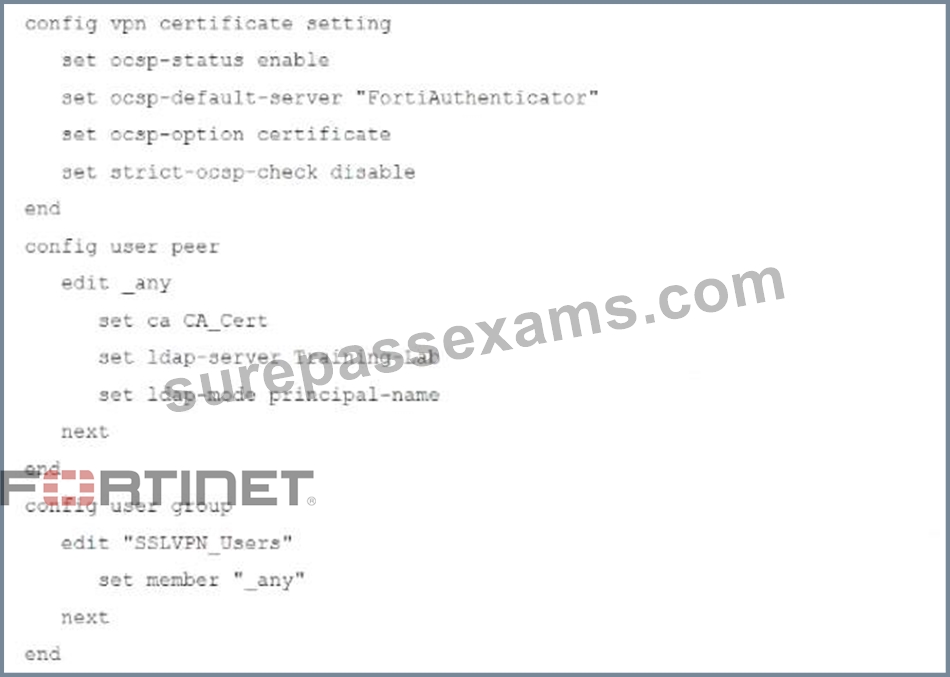
Based on this configuration, which authentication scenario will FortiGate deny?
- A. FortiAuthenticator responds to an OCSP request that the user certificate authority is untrusted.
- B. FortiAuthenticator responds to an OCSP request that the user certificate status is unknown.
- C. The user certificate does not contain the OCSP URL.
Answer: A
NEW QUESTION # 64
Review the Application Control log.
Which configuration caused the IPS engine to generate this log?
- A.
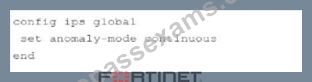
- B.

- C.
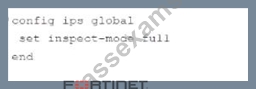
- D.
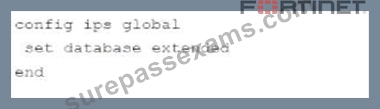
Answer: C
NEW QUESTION # 65
SD-WAN is configured on a FortiGate. You notice that when one of the internet links has high latency the time to resolve names using DNS from FortiGate is very high.
You must ensure that the FortiGate DNS resolution times are as low as possible with the least amount of work.
What should you configure?
- A. Configure two DNS servers and use DNS servers recommended by the two internet providers.
- B. Configure an SD-WAN rule to the DNS server and use the FortiGate interface IPs in the source address.
- C. Configure local out traffic to use the outgoing interface based on SD-WAN rules with a manual defined IP associated to a loopback interface and configure an SD-WAN rule from the loopback to the DNS server.
- D. Configure local out traffic to use the outgoing interface based on SD-WAN rules with the interface IP and configure an SD-WAN rule to the DNS server.
Answer: D
Explanation:
SD-WAN is a feature that allows users to optimize network performance and reliability by using multiple WAN links and applying rules based on various criteria, such as latency, jitter, packet loss, etc. One way to ensure that the FortiGate DNS resolution times are as low as possible with the least amount of work is to configure local out traffic to use the outgoing interface based on SD-WAN rules with the interface IP and configure an SD-WAN rule to the DNS server. This means that the FortiGate will use the best WAN link available to send DNS queries to the DNS server according to the SD-WAN rule, and use its own interface IP as the source address. This avoids NAT issues and ensures optimal DNS performance. References:
https://docs.fortinet.com/document/fortigate/7.0.0/sd-wan/19662/sd-wan
NEW QUESTION # 66
You are migrating the branches of a customer to FortiGate devices. They require independent routing tables on the LAN side of the network.
After reviewing the design, you notice the firewall will have many BGP sessions as you have two data centers (DC) and two ISPs per DC while each branch is using at least 10 internal segments.
Based on this scenario, what would you suggest as the more efficient solution, considering that in the future the number of internal segments, DCs or internet links per DC will increase?
- A. Acquire a FortiGate model with more capacity, considering the next 5 years growth.
- B. Implement network-id, neighbor-group and increase the advertisement-interval
- C. Redesign the SD-WAN deployment to only use a single VPN tunnel and segment traffic using VRFs on BGP
- D. No change in design is needed as even small FortiGate devices have a large memory capacity.
Answer: C
Explanation:
https://docs.fortinet.com/document/fortigate/7.4.1/administration-guide/810981/sd-wan-segmentation-over-a- single-overlay
NEW QUESTION # 67
Refer to the exhibits.
Exhibit A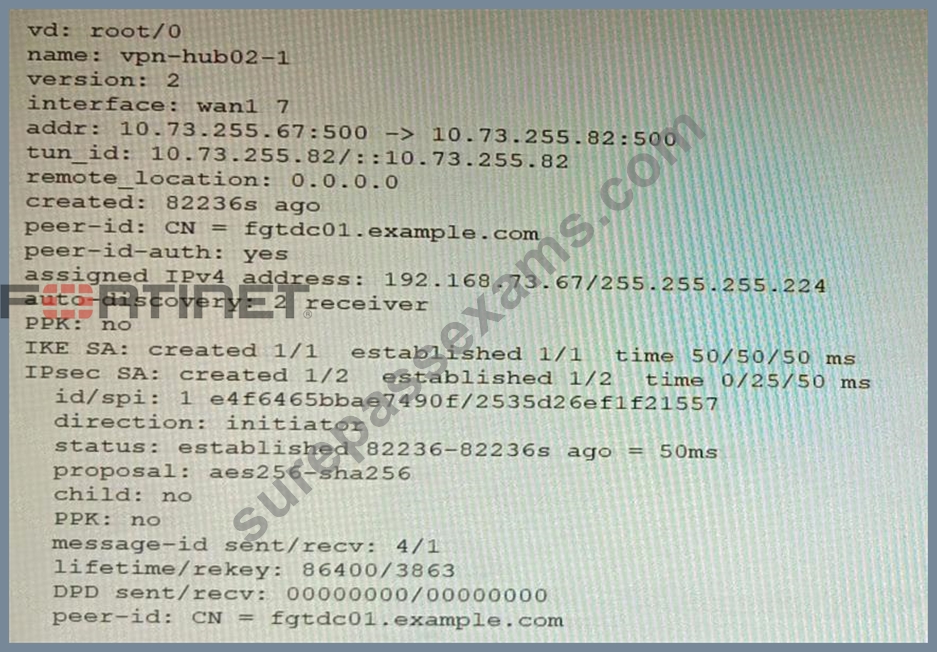
Exhibit B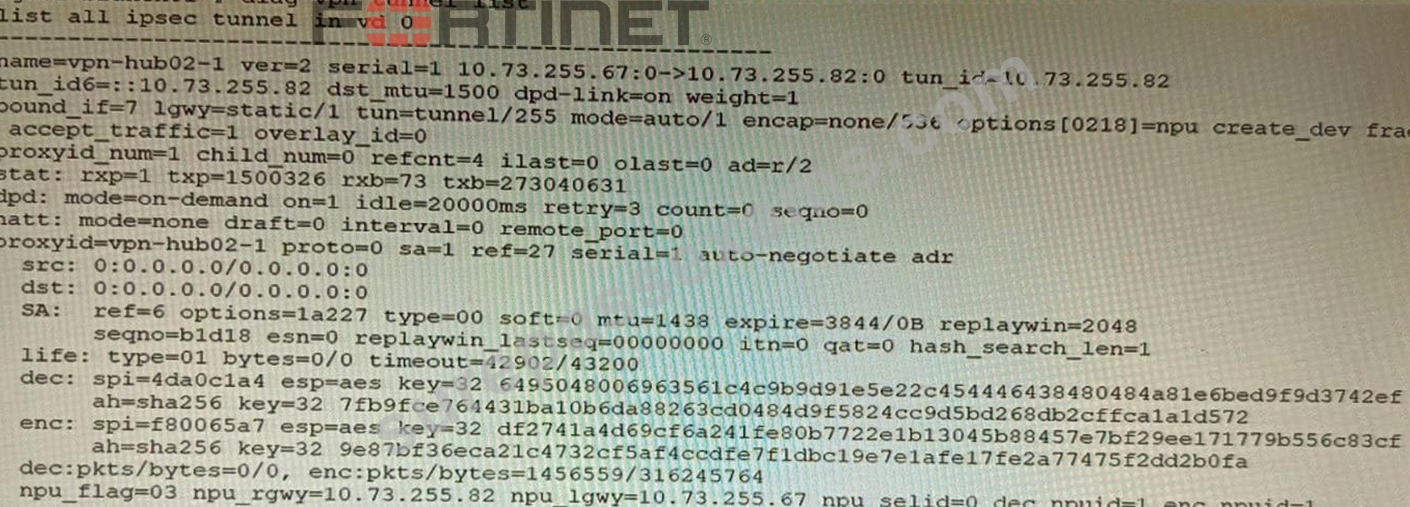
Exhibit C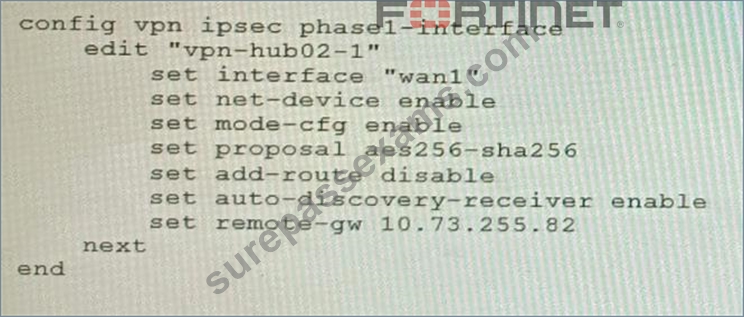
A customer is trying to set up a VPN with a FortiGate, but they do not have a backup of the configuration.
Output during a troubleshooting session is shown in the exhibits A and B and a baseline VPN configuration is shown in Exhibit C Referring to the exhibits, which configuration will restore VPN connectivity?
- A.
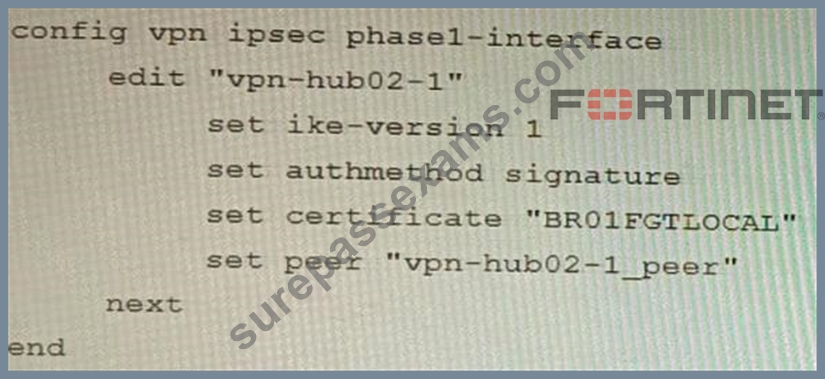
- B.
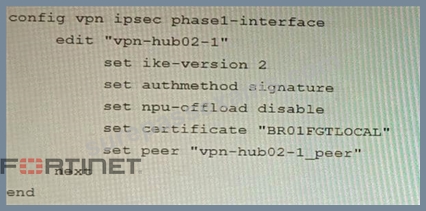
- C.
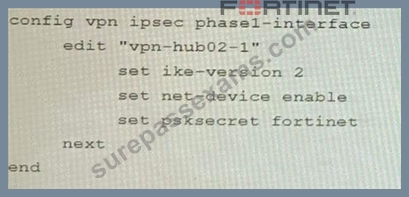
- D.
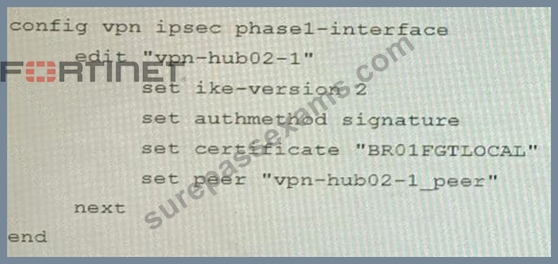
Answer: B
Explanation:
The output in Exhibit A shows that the VPN tunnel is not established because the peer IP address is incorrect.
The output in Exhibit B shows that the peer IP address is 192.168.1.100, but the baseline VPN configuration in Exhibit C shows that the peer IP address should be 192.168.1.101.
To restore VPN connectivity, you need to change the peer IP address in the VPN tunnel configuration to
192.168.1.101. The correct configuration is shown below:
config vpn ipsec phase1-interface
edit "wan"
set peer-ip 192.168.1.101
set peer-id 192.168.1.101
set dhgrp 1
set auth-mode psk
set psk SECRET_PSK
next
end
Option A is incorrect because it does not change the peer IP address. Option B is incorrect because it changes the peer IP address to 192.168.1.100, which is the incorrect IP address. Option D is incorrect because it does not include the necessary configuration for the VPN tunnel.
NEW QUESTION # 68
Refer to the exhibit, which shows an SD-WAN configuration.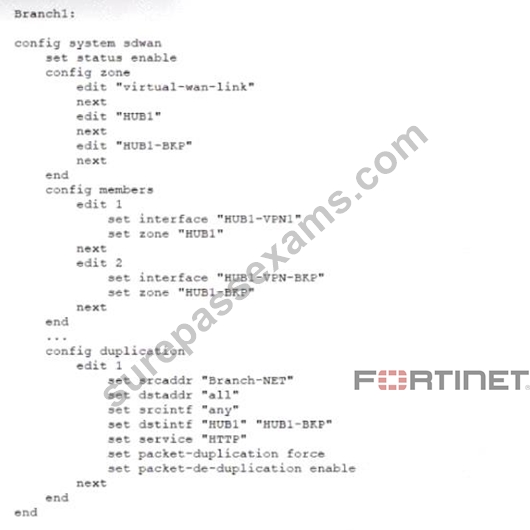
You configured the SD-WAN from Branch1 to the HUB and enabled packet duplication. You later notice that the traffic is not being duplicated. In this scenario, what is causing this problem?
- A. Traffic cannot be duplicated over multiple zones.
- B. Packet duplication is not enabled on the HUB side.
- C. Packet duplication did not occur because an interface is out of SLA.
- D. There is a mismatch in the FortiOS version between Branch1 and HUB.
Answer: A
NEW QUESTION # 69
Refer to the CLI output: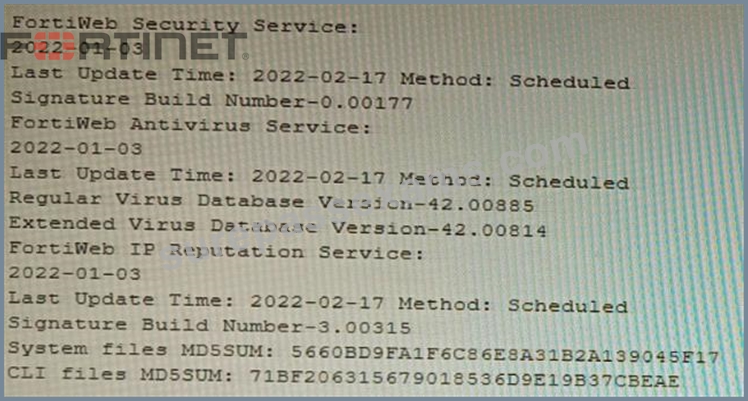
Given the information shown in the output, which two statements are correct? (Choose two.)
- A. Geographical IP policies are enabled and evaluated after local techniques.
- B. An IP address that was previously used by an attacker will always be blocked
- C. The IP Reputation feature has been manually updated
- D. Reputation from blacklisted IP addresses from DHCP or PPPoE pools can be restored
- E. Attackers can be blocked before they target the servers behind the FortiWeb.
Answer: D,E
Explanation:
The CLI output shown in the exhibit indicates that FortiWeb has enabled IP Reputation feature with local techniques enabled and geographical IP policies enabled after local techniques (set geoip-policy-order after-local). IP Reputation feature is a feature that allows FortiWeb to block or allow traffic based on the reputation score of IP addresses, which reflects their past malicious activities or behaviors. Local techniques are methods that FortiWeb uses to dynamically update its own blacklist based on its own detection of attacks or violations from IP addresses (such as signature matches, rate limiting, etc.). Geographical IP policies are rules that FortiWeb uses to block or allow traffic based on the geographical location of IP addresses (such as country, region, city, etc.). Therefore, based on the output, one correct statement is that attackers can be blocked before they target the servers behind the FortiWeb. This is because FortiWeb can use IP Reputation feature to block traffic from IP addresses that have a low reputation score or belong to a blacklisted location, which prevents them from reaching the servers and launching attacks. Another correct statement is that reputation from blacklisted IP addresses from DHCP or PPPoE pools can be restored. This is because FortiWeb can use local techniques to remove IP addresses from its own blacklist if they stop sending malicious traffic for a certain period of time (set local-techniques-expire-time), which allows them to regain their reputation and access the servers. This is useful for IP addresses that are dynamically assigned by DHCP or PPPoE and may change frequently. References: https://docs.fortinet.com/document/fortiweb/6.4.0/administration-guide/19662/ip-reputation https://docs.fortinet.com/document/fortiweb/6.4.0/administration-guide/19662/geographical-ip-policies
NEW QUESTION # 70
Refer to the exhibits.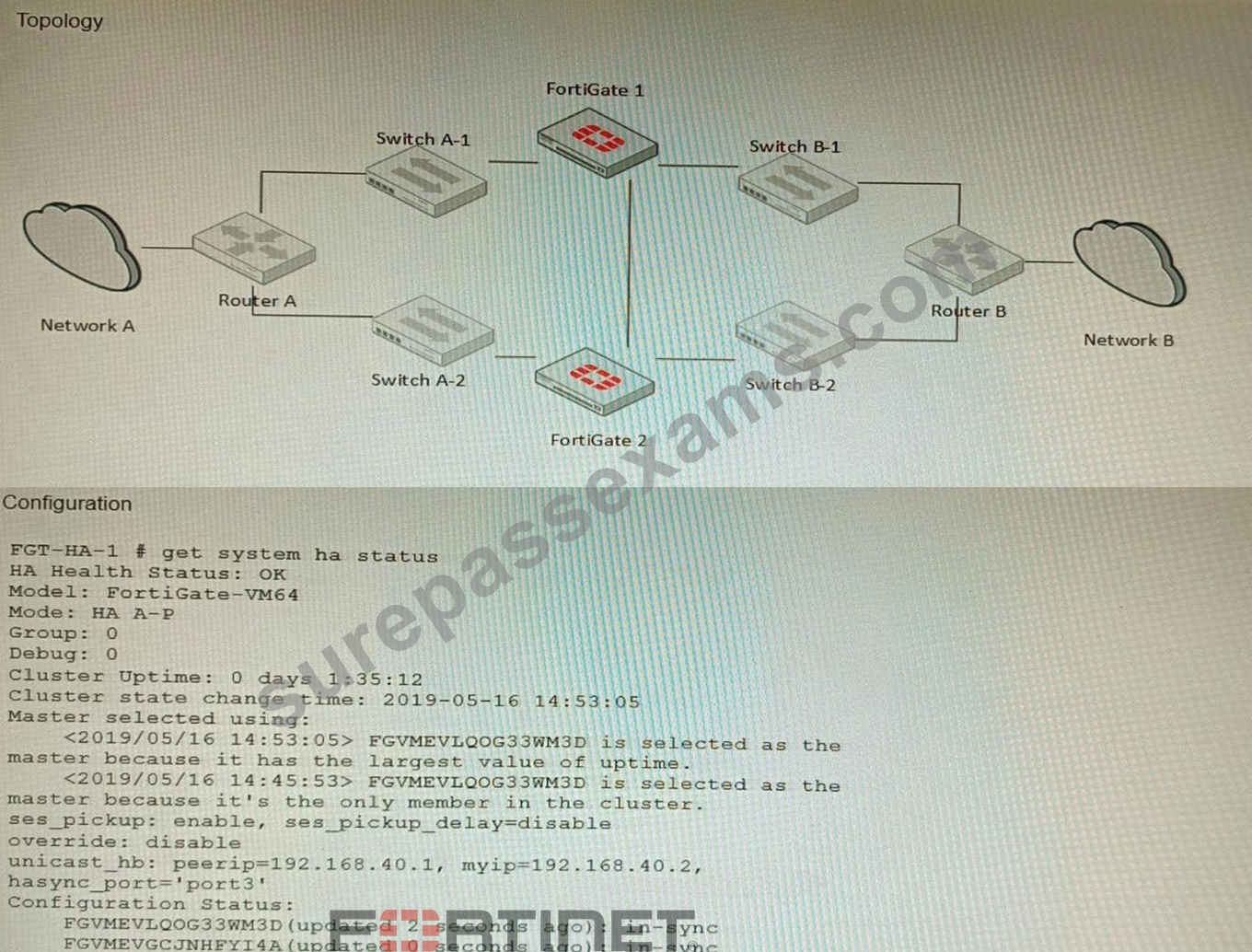
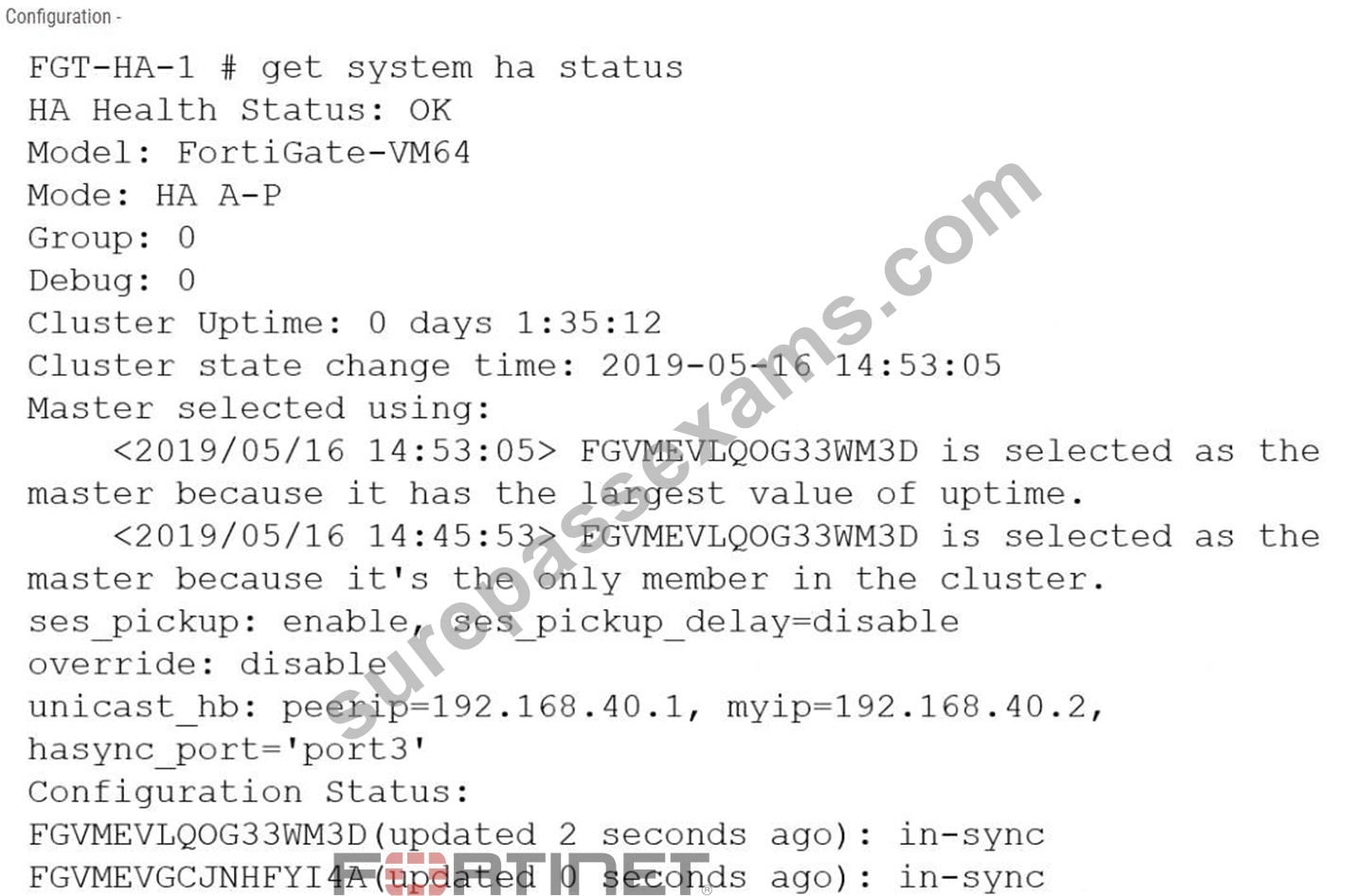
The exhibits show a FortiGate network topology and the output of the status of high availability on the FortiGate.
Given this information, which statement is correct?
- A. FGVMEVLQOG33WM3D and FGVMEVGCJNHFYI4A share a virtual MAC address.
- B. The cluster members are on the same network and the IP addresses were statically assigned.
- C. The cluster mode can support a maximum of four (4) FortiGate VMs
- D. The ethertype values of the HA packets are 0x8890, 0x8891, and 0x8892
Answer: B
Explanation:
The output of the status of high availability on the FortiGate shows that the cluster mode is active-passive, which means that only one FortiGate unit is active at a time, while the other unit is in standby mode. The active unit handles all traffic and also sends HA heartbeat packets to monitor the standby unit. The standby unit becomes active if it stops receiving heartbeat packets from the active unit, or if it receives a higher priority from another cluster unit. In active-passive mode, all cluster units share a virtual MAC address for each interface, which is used as the source MAC address for all packets forwarded by the cluster. References:
https://docs.fortinet.com/document/fortigate/6.4.0/cookbook/103439/high-availability-with-two-fortigates
NEW QUESTION # 71
Refer to the exhibits.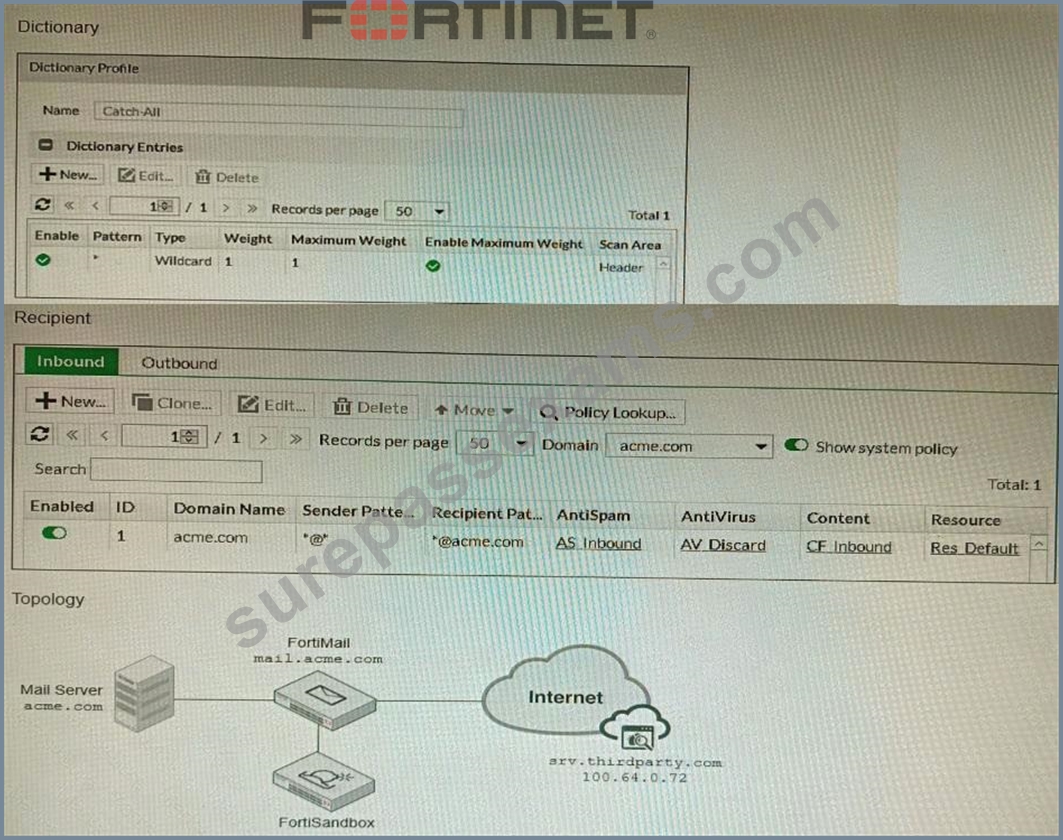
The exhibits show a FortiMail network topology, Inbound configuration settings, and a Dictionary Profile.
You are required to integrate a third-party's host service (srv.thirdparty.com) into the e-mail processing path.
All inbound e-mails must be processed by FortiMail antispam and antivirus with FortiSandbox integration. If the email is clean, FortiMail must forward it to the third-party service, which will send the email back to FortiMail for final delivery, FortiMail must not scan the e-mail again.
Which three configuration tasks must be performed to meet these requirements? (Choose three.)
- A. Change the scan order in FML-GW to antispam-sandbox-content.
- B. Create an IP policy with a Source value of 100. 64 .0.72/32, enable precedence, and place the policy at the top of the list.
- C. Apply the Catch-AII profile to the ASinbound profile and configure an access delivery rule to deliver to the 100.64.0.72 host.
- D. Apply the Catch-Ail profile to the CFInbound profile and configure a content action profile to deliver to the srv. thirdparty. com FQDN
- E. Create an access receive rule with a Sender value of srv. thirdparcy.com, Recipient value of *@acme.
com, and action value of Safe
Answer: A,B,D
Explanation:
* A is correct because the scan order must be changed to antispam-sandbox-content in order for FortiMail to scan the email for spam and viruses before forwarding it to the third-party service.
* B is correct because the Catch-All profile must be applied to the CFInbound profile in order for FortiMail to forward clean emails to the third-party service.
* E is correct because an IP policy must be created with a Source value of 100.64.0.72/32 in order to allow emails from the third-party service to be delivered to FortiMail.
The other options are not necessary to meet the requirements. Option C is not necessary because the access receive rule will already allow emails from the third-party service to be received by FortiMail. Option D is not necessary because the Catch-All profile already allows emails to be delivered to any destination.
Here are some additional details about integrating a third-party service into the FortiMail email processing path:
* The third-party service must be able to receive emails from FortiMail and send them back to FortiMail.
* The third-party service must be able to communicate with FortiMail using the SMTP protocol.
* The third-party service must be able to authenticate with FortiMail using the SMTP AUTH protocol.
Once the third-party service is integrated into the FortiMail email processing path, all inbound emails will be processed by FortiMail as usual. If the email is clean, FortiMail will forward it to the third-party service. The third-party service will then send the email back to FortiMail for final delivery. FortiMail will not scan the email again.
NEW QUESTION # 72
Which two statements are correct on a FortiGate using the FortiGuard Outbreak Protection Service (VOS)? (Choose two.)
- A. The AV engine scan must be enabled to use the FortiGuard VOS feature
- B. The antivirus database queries FortiGuard with the hash of a scanned file
- C. The hash signatures are obtained from the FortiGuard Global Threat Intelligence database.
- D. The FortiGuard VOS can be used only with proxy-base policy inspections.
- E. If third-party AV database returns a match the scanned file is deemed to be malicious.
Answer: B,C
Explanation:
c) The antivirus database queries FortiGuard with the hash of a scanned file. This is how the FortiGuard VOS service works. The FortiGate queries FortiGuard with the hash of a scanned file, and FortiGuard returns a list of known malware signatures that match the hash.
e) The hash signatures are obtained from the FortiGuard Global Threat Intelligence database. This is where the FortiGuard VOS service gets its hash signatures from. The FortiGuard Global Threat Intelligence database is updated regularly with new malware signatures.
NEW QUESTION # 73
A retail customer with a FortiADC HA cluster load balancing five webservers in L7 Full NAT mode is receiving reports of users not able to access their website during a sale event. But for clients that were able to connect, the website works fine.
CPU usage on the FortiADC and the web servers is low, application and database servers are still able to handle more traffic, and the bandwidth utilization is under 30%.
Which two options can resolve this situation? (Choose two.)
- A. Change the persistence rule to LB_PERSIS_SSL_SESSJD.
- B. Add a connection-pool to the FortiADC virtual server
- C. Add more web servers to the real server poof
- D. Disable SSL between the FortiADC and the web servers
Answer: A,B
Explanation:
The FortiADC HA cluster is a load balancing solution that distributes traffic among multiple web servers in L7 Full NAT mode. L7 Full NAT mode means that FortiADC terminates both client and server SSL connections and performs full NAT for both source and destination IP addresses and ports. One possible reason for users not being able to access the website during a sale event is that the persistence rule is not configured properly. Persistence rule is a feature that ensures that subsequent requests from the same client are sent to the same web server, which is important for maintaining session continuity and avoiding errors or data loss. The default persistence rule for L7 Full NAT mode is LB_PERSIS_SRC_IP, which uses the source IP address of the client as the persistence key. However, this rule may not work well if there are many clients behind a proxy or NAT device that share the same source IP address, or if there are clients that change their source IP address frequently due to roaming or switching networks. Therefore, to resolve this situation, one option is to change the persistence rule to LB_PERSIS_SSL_SESSJD, which uses the SSL session ID of the client as the persistence key. This rule can provide more accurate and reliable persistence for SSL connections than LB_PERSIS_SRC_IP. Another possible reason for users not being able to access the website during a sale event is that there are too many TCP connections being established and terminated between FortiADC and the web servers, which consumes CPU resources and causes performance degradation. Therefore, to resolve this situation, another option is to add a connection-pool to the FortiADC virtual server. Connection-pool is a feature that allows FortiADC to reuse existing TCP connections between FortiADC and the web servers, instead of creating new ones for each request. This can reduce CPU overhead, improve response time, and increase throughput. Reference: https://docs.fortinet.com/document/fortiadc/6.4.0/administration-guide/19662/load-balancing-methods-and-persistence https://docs.fortinet.com/document/fortiadc/6.4.0/administration-guide/19662/connection-pool
NEW QUESTION # 74
Refer to the exhibit showing the history logs from a FortiMail device.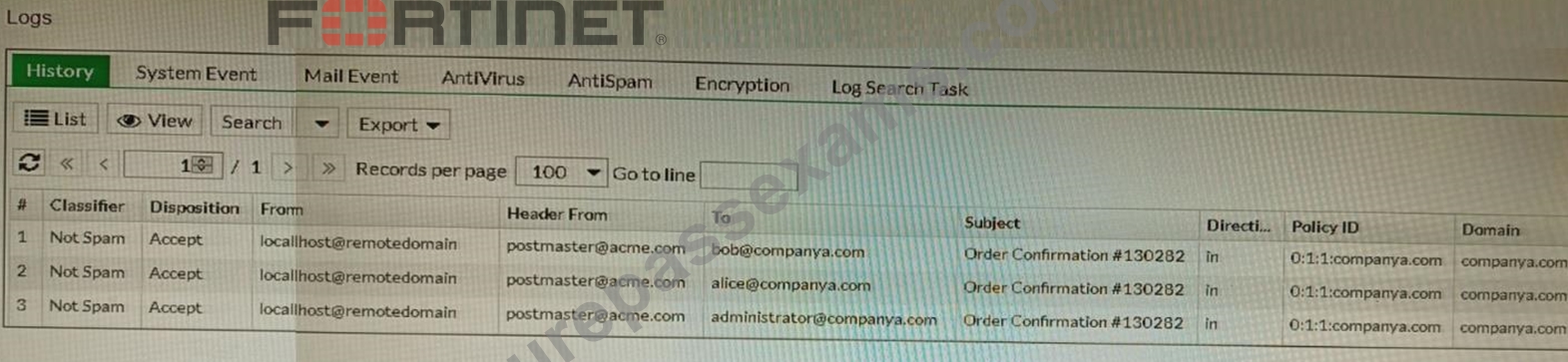
Which FortiMail email security feature can an administrator enable to treat these emails as spam?
- A. DKIM validation in a session profile
- B. Sender domain validation in a session profile
- C. Soft fail SPF validation in an antispam profile
- D. Impersonation analysis in an antispam profile
Answer: D
Explanation:
Impersonation analysis is a feature that detects emails that attempt to impersonate a trusted sender, such as a company executive or a well-known brand, by using spoofed or look-alike email addresses. This feature can help prevent phishing and business email compromise (BEC) attacks. Impersonation analysis can be enabled in an antispam profile and applied to a firewall policy. Reference: https://docs.fortinet.com/document/fortimail/6.4.0/administration-guide/103663/impersonation-analysis
NEW QUESTION # 75
Refer to the exhibits.
The exhibits show a diagram of a requested topology and the base IPsec configuration.
A customer asks you to configure ADVPN via two internet underlays. The requirement is that you use one interface with a single IP address on DC FortiGate.
In this scenario, which feature should be implemented to achieve this requirement?
- A. Change advpn2 to IKEv1
- B. Use peer-id
- C. Use network-overlay id
- D. Use local-id
Answer: C
Explanation:
A is correct because using network-overlay id allows you to configure multiple ADVPN tunnels on a single interface with a single IP address on the DC FortiGate. This is explained in the FortiGate Administration Guide under ADVPN > Configuring ADVPN > Configuring ADVPN on the hub. References: https://docs.fortinet.com/document/fortigate/7.4.0/administration-guide/978793/advpn https://docs.fortinet.com/document/fortigate/7.4.0/administration-guide/978793/advpn/978794/configuring-advpn
NEW QUESTION # 76
What is the benefit of using FortiGate NAC LAN Segments?
- A. It provides physical isolation without changing the IP address of hosts.
- B. It provides support for multiple DHCP servers within the same VLAN.
- C. It allows for assignment of dynamic address objects matching NAC policy.
- D. It provides support for IGMP snooping between hosts within the same VLAN
Answer: C
Explanation:
FortiGate NAC LAN Segments are a feature that allows users to assign different VLANs to different LAN segments without changing the IP address of hosts or bouncing the switch port. This provides physical isolation while maintaining firewall sessions and avoiding DHCP issues. One benefit of using FortiGate NAC LAN Segments is that it allows for assignment of dynamic address objects matching NAC policy. This means that users can create firewall policies based on dynamic address objects that match the NAC policy criteria, such as device type, OS type, MAC address, etc. This simplifies firewall policy management and enhances security by applying different security profiles to different types of devices. References: https://docs.fortinet.com/document/fortigate/7.0.0/new-features/856212/nac-lan-segments-7-0-1
NEW QUESTION # 77
You are migrating the branches of a customer to FortiGate devices. They require independent routing tables on the LAN side of the network.
After reviewing the design, you notice the firewall will have many BGP sessions as you have two data centers (DC) and two ISPs per DC while each branch is using at least 10 internal segments.
Based on this scenario, what would you suggest as the more efficient solution, considering that in the future the number of internal segments, DCs or internet links per DC will increase?
- A. Acquire a FortiGate model with more capacity, considering the next 5 years growth.
- B. Implement network-id, neighbor-group and increase the advertisement-interval
- C. Redesign the SD-WAN deployment to only use a single VPN tunnel and segment traffic using VRFs on BGP
- D. No change in design is needed as even small FortiGate devices have a large memory capacity.
Answer: C
Explanation:
Using multiple VPN tunnels and BGP sessions for each internal segment is not scalable and efficient, especially when the number of segments, DCs or internet links per DC increases. A better solution is to use a single VPN tunnel per branch and segment traffic using virtual routing and forwarding (VRF) instances on BGP. This way, each VRF can have its own routing table and BGP session, while sharing the same VPN tunnel. Reference: https://docs.fortinet.com/document/fortigate/6.4.0/cookbook/103439/sd-wan-with-vrf-and-bgp
NEW QUESTION # 78
You want to use the MTA adapter feature on FortiSandbox in an HA-Cluster. Which statement about this solution is true?
- A. The MTA adapter mode is only detection mode.
- B. The configuration of the MTA Adapter Local Interface is different than on port1.
- C. The MTA adapter is only available in the primary node.
- D. The configuration is different than on a standalone device.
Answer: C
Explanation:
The MTA adapter feature on FortiSandbox is a feature that allows FortiSandbox to act as a mail transfer agent (MTA) that can receive, inspect, and forward email messages from external sources. The MTA adapter feature can be used to integrate FortiSandbox with third-party email security solutions that do not support direct integration with FortiSandbox, such as Microsoft Exchange Server or Cisco Email Security Appliance (ESA). The MTA adapter feature can also be used to enhance email security by adding an additional layer of inspection and filtering before delivering email messages to the final destination. The MTA adapter feature can be enabled on FortiSandbox in an HA-Cluster, which is a configuration that allows two FortiSandbox units to synchronize their settings and data and provide high availability and load balancing for sandboxing services. However, one statement about this solution that is true is that the MTA adapter is only available in the primary node. This means that only one FortiSandbox unit in the HA-Cluster can act as an MTA and receive email messages from external sources, while the other unit acts as a backup node that can take over the MTA role if the primary node fails or loses connectivity. This also means that only one IP address or FQDN can be used to configure the external sources to send email messages to the FortiSandbox MTA, which is the IP address or FQDN of the primary node. Reference: https://docs.fortinet.com/document/fortisandbox/3.2.0/administration-guide/19662/mail-transfer-agent-mta https://docs.fortinet.com/document/fortisandbox/3.2.0/administration-guide/19662/high-availability-ha
NEW QUESTION # 79
You want to use the MTA adapter feature on FortiSandbox in an HA-Cluster. Which statement about this solution is true?
- A. The MTA adapter mode is only detection mode.
- B. The configuration of the MTA Adapter Local Interface is different than on port1.
- C. The MTA adapter is only available in the primary node.
- D. The configuration is different than on a standalone device.
Answer: C
Explanation:
The MTA adapter feature on FortiSandbox is a feature that allows FortiSandbox to act as a mail transfer agent (MTA) that can receive, inspect, and forward email messages from external sources. The MTA adapter feature can be used to integrate FortiSandbox with third-party email security solutions that do not support direct integration with FortiSandbox, such as Microsoft Exchange Server or Cisco Email Security Appliance (ESA). The MTA adapter feature can also be used to enhance email security by adding an additional layer of inspection and filtering before delivering email messages to the final destination. The MTA adapter feature can be enabled on FortiSandbox in an HA-Cluster, which is a configuration that allows two FortiSandbox units to synchronize their settings and data and provide high availability and load balancing for sandboxing services. However, one statement about this solution that is true is that the MTA adapter is only available in the primary node. This means that only one FortiSandbox unit in the HA-Cluster can act as an MTA and receive email messages from external sources, while the other unit acts as a backup node that can take over the MTA role if the primary node fails or loses connectivity. This also means that only one IP address or FQDN can be used to configure the external sources to send email messages to the FortiSandbox MTA, which is the IP address or FQDN of the primary node. References: https://docs.fortinet.com/document/fortisandbox/3.2.0/administration-guide/19662/mail-transfer-agent-mta https://docs.fortinet.com/document/fortisandbox/3.2.0/administration-guide/19662/high-availability-ha
NEW QUESTION # 80
You are troubleshooting a FortiMail Cloud service integrated with Office 365 where outgoing emails are not reaching the recipients' mail What are two possible reasons for this problem? (Choose two.)
- A. The FortiMail access control rules to relay from Office 365 servers public IPs are missing.
- B. The FortiMail DKIM key was not set using the Auto Generation option.
- C. The FortiMail access control rule to relay from Office 365 servers FQDN is missing.
- D. A Mail Flow connector from the Exchange Admin Center has not been set properly to the FortiMail Cloud FQDN.
Answer: A,D
Explanation:
FortiMail Cloud service is a cloud-based email security solution that integrates with Office 365 to provide protection against spam, malware, phishing, data loss, etc. To use FortiMail Cloud service with Office 365, users need to configure both FortiMail Cloud settings and Office 365 settings properly. One possible reason for outgoing emails not reaching the recipients' mailboxes is that the FortiMail access control rules to relay from Office 365 servers public IPs are missing. This means that FortiMail Cloud service does not recognize the Office 365 servers as authorized senders and rejects the outgoing emails. Users need to add the Office 365 servers public IPs to the FortiMail access control rules to allow relaying. Another possible reason for outgoing emails not reaching the recipients' mailboxes is that a Mail Flow connector from the Exchange Admin Center has not been set properly to the FortiMail Cloud FQDN. This means that Office 365 does not route the outgoing emails to the FortiMail Cloud service for scanning and delivery. Users need to create a Mail Flow connector from the Exchange Admin Center and specify the FortiMail Cloud FQDN as the smart host. Reference: https://docs.fortinet.com/document/fortimail-cloud/6.4.0/administration-guide/19662/integrating-fortimail-cloud-with-office-365
NEW QUESTION # 81
Refer to the exhibits.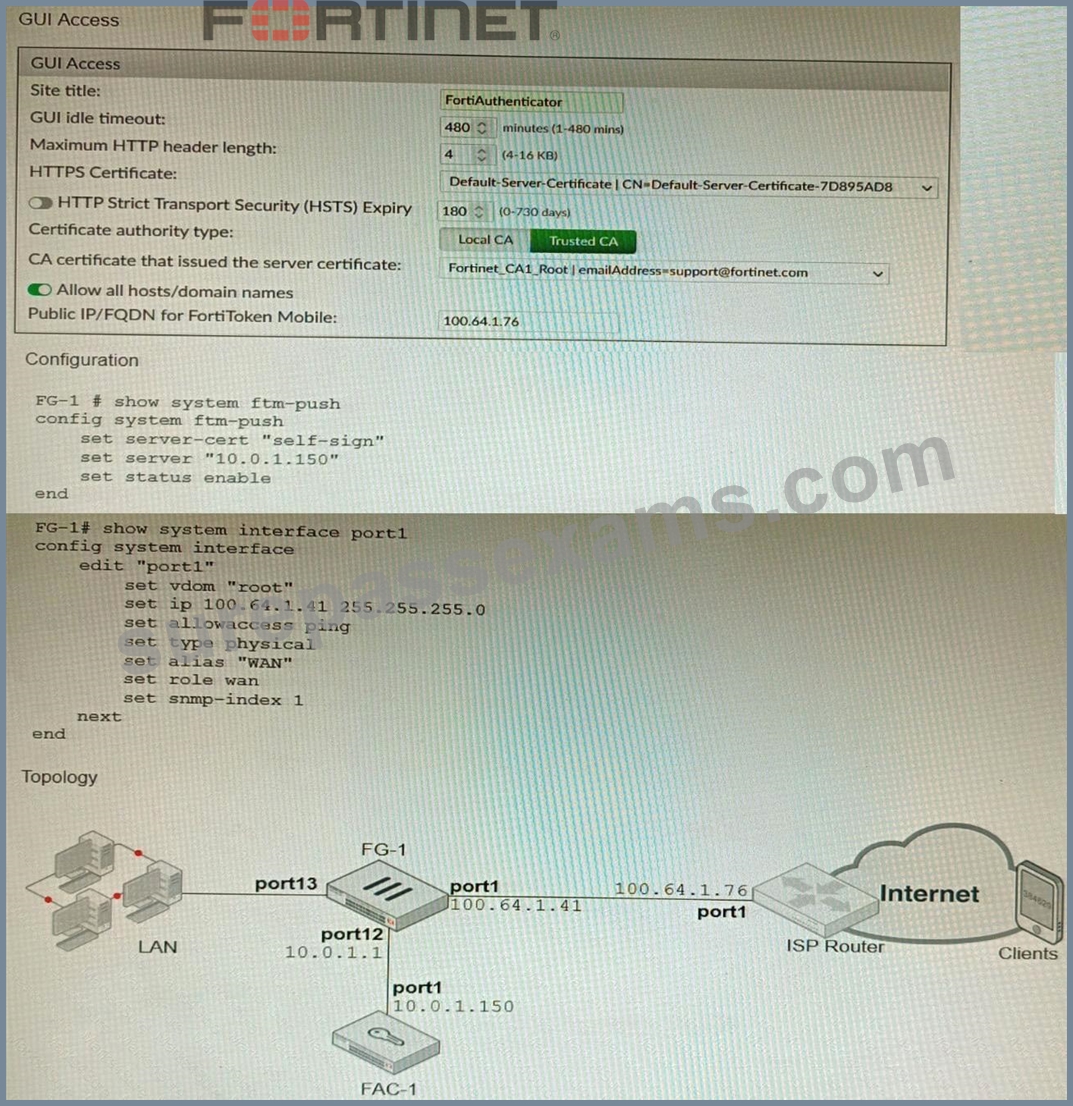
An administrator has configured a FortiGate and Forti Authenticator for two-factor authentication with FortiToken push notifications for their SSL VPN login. Upon initial review of the setup, the administrator has discovered that the customers can manually type in their two-factor code and authenticate but push notifications do not work Based on the information given in the exhibits, what must be done to fix this?
- A. On FAC-1, the FortiToken public IP setting must point to 100.64.1 41
- B. On FG-1 port1, the ftm access protocol must be enabled.
- C. On FG-1 CLI, the ftm-push server setting must point to 100.64.141.
- D. FAC-1 must have an internet routable IP address for push notifications.
Answer: A
Explanation:
https://community.fortinet.com/t5/FortiAuthenticator/Technical-Tip-FortiToken-Push-on-FortiAuthenticator- operation/ta-p/190810
NEW QUESTION # 82
Which feature must you enable on the BGP neighbors to accomplish this goal?
- A. Deterministic-med
- B. Synchronization
- C. Graceful-restart
- D. Soft-reconfiguration
Answer: C
Explanation:
Graceful-restart is a feature that allows BGP neighbors to maintain their routing information during a BGP restart or failover event, without disrupting traffic forwarding or causing route flaps. Graceful-restart works by allowing a BGP speaker (the restarting router) to notify its neighbors (the helper routers) that it is about to restart or failover, and request them to preserve their routing information and forwarding state for a certain period of time (the restart time). The helper routers then mark the routes learned from the restarting router as stale, but keep them in their routing table and continue forwarding traffic based on them until they receive an end-of-RIB marker from the restarting router or until the restart time expires. This way, graceful-restart can minimize traffic disruption and routing instability during a BGP restart or failover event. References:
https://docs.fortinet.com/document/fortigate/7.0.0/cookbook/19662/bgp-graceful-restart
NEW QUESTION # 83
......
NSE8_812 Exam Dumps For Certification Exam Preparation: https://certmagic.surepassexams.com/NSE8_812-exam-bootcamp.html